How to Plan a Casino Route Around Clear Choices
Plan a casino route by mapping each hand-off from entrance to destination, spotting unclear connections and deciding what to confirm before sharing directions.
How do you plan a casino route that a first-time visitor can follow without guessing? A casino route works best when its starting entrance, intermediate hand-offs and destination are described as one connected journey.
Think of it like a parcel passing through a sorting depot: each hand-off has to lead to the next one. For casino visitors, the hand-offs may run from a public entrance to a host point, through a shared lobby and on to a restaurant, gaming area or event room.
Define the route by its hand-offs
Start with one named public entrance and one precise destination. Then list the places where the visitor must make a decision: a reception desk, a corridor split, a floor change or a controlled doorway.
Use names a visitor can match to signs or venue information. Avoid internal department labels unless visitors will see them, and do not treat “the main entrance” as clear if the venue has several public doors.
Show where the journey changes character
A route can shift from an open public space to a hosted area, an event queue or a controlled entrance. Mark that transition in the directions so visitors know when to look for staff or follow event-specific instructions rather than continuing along the usual public route.
Casino floors can also have several visually similar corridors and entrances. Describe the next decision point, not every decoration along the way; a useful cue tells the visitor what action to take, such as continuing past a named desk or turning towards a named area.
Separate route choices that do not connect in the same way
If one option uses stairs and another uses a lift, describe them from the point where they split. Say where each begins, what destination or level it reaches, and where it rejoins the journey if it does.
Do not present different paths as interchangeable just because they lead towards the same area. If the venue has not confirmed how a route connects to the destination, mark that gap and ask for clarification instead of filling it with an assumption.
Check how casino routes handle arrivals and events
During a show, tournament or busy arrival period, the route from the entrance may lead first to a host, ticket check or queue. Confirm the intended arrival sequence for that visit, then make the directions distinguish the normal approach from any event-specific hand-off.
When information from a map and a host conflicts, do not combine the two accounts into a single route. Ask the venue which instruction applies to the visitor’s destination and arrival, then revise the directions to match.
Which details make a casino route usable?
How should I choose a starting entrance?
Name the public door the visitor is expected to use, rather than relying on a vague label such as “front”. If the arrival point is not confirmed, ask the venue which entrance applies to the visit before writing the first direction.
What should I do if the route reaches a host or queue?
State that the hand-off occurs and identify the host point or queue using the venue’s own wording. If the next route segment depends on staff instructions, tell the visitor to ask there rather than suggesting an unconfirmed continuation.
How do I describe a route split?
Name the point where the options separate and describe each path independently. Include where each path leads or rejoins only when the venue has confirmed that connection.
How can I tell whether directions are ready to share?
Check that every decision point has a clear next action and that the destination has a recognisable venue name. If any hand-off is uncertain, identify the missing detail and seek confirmation before presenting the route as complete.
Use these checks before sharing directions
For each observation, choose the stated action; if the detail is not confirmed, use the alternative rather than asking visitors to guess.
- Check whether the arrival entrance is named in the visit information; if it is, use that entrance as the start, but if it is not, ask the venue which public door applies and begin the route there.
- Check whether the destination name matches the venue’s visitor-facing wording; if it does, keep that name, but if it does not, request the current name before drafting the final direction.
- Check whether a host, queue or ticket point interrupts the direct route; if one is confirmed, include it as a hand-off, but if its role is unclear, ask the venue what visitors should do on arrival.
- Check whether a corridor split has a named direction or destination cue; if it does, give that cue, but if it does not, request a description of the correct branch rather than guessing.
- Check whether stairs and a lift lead to the same relevant part of the journey; if both connections are confirmed, describe each separately, but if either connection is uncertain, state that it needs confirmation and ask for the route details.
- Check whether an event changes the arrival sequence; if the venue confirms no change, use the standard hand-offs, but if it confirms a changed sequence, replace the affected directions with the event instructions.
- Check whether the final doorway can be distinguished from nearby entrances; if a venue-confirmed name or sign identifies it, include that cue, but if not, ask how visitors should recognise the correct arrival point.
Work through a route with a missing hand-off
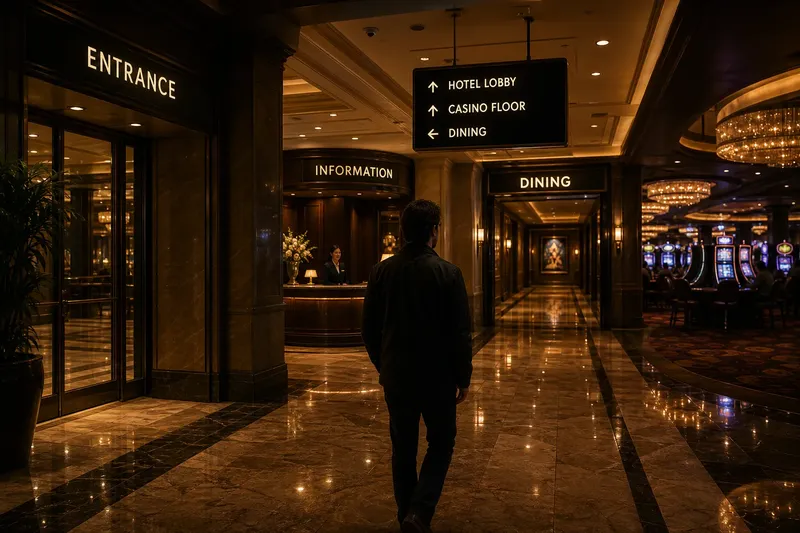
Imagine a visitor needs directions from a casino’s public entrance to a restaurant during an evening event. The venue information names the entrance, an information desk and a corridor marked “Dining”; it says the corridor starts to the left of the desk, but gives no cue for distinguishing the restaurant door from nearby doors.
Set the public entrance as the start and the restaurant as the destination. Record the information desk, the left turn and the “Dining” corridor as confirmed hand-offs, then mark the final doorway as unresolved. The decision is to share the confirmed sequence only if the directions clearly flag the missing arrival cue, while asking the venue how to identify the restaurant entrance; do not invent a sign or landmark.
Make the final arrival point unmistakable
A visitor needs a clear signal that the route has ended at the intended destination, not merely at the right corridor. Use a confirmed doorway name, sign or host point; if none is available, ask the venue for an arrival cue before calling the directions complete.
When you review a casino route, follow it from hand-off to hand-off and check what the visitor should do at each one. That small discipline catches the most consequential gap: directions that sound complete until the visitor reaches the last turn and has no way to tell which door is theirs.