From Station Approach to Destination Entrance
Casino destination arrival design helps planners make a venue entrance easy to identify while keeping shared transport spaces legible for every visitor.
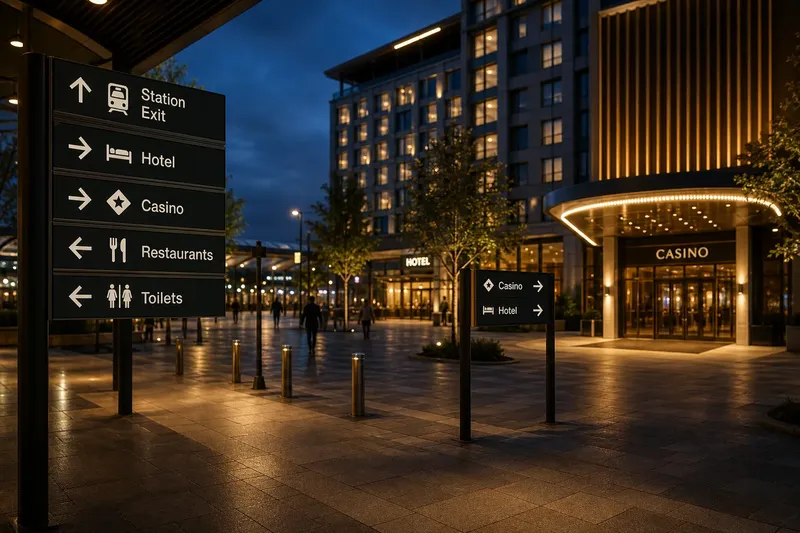
How can casino destination arrival design make a venue easy to find without turning the surrounding transport space into a branded corridor? Start with the arrival sequence: a person leaves a station, spots the destination, and reaches its entrance without mistaking nearby public amenities for part of the venue.
At a transport hub near a casino, a station exit might open onto a broad plaza with a hotel, food outlets and several onward routes. Treat the arrival as a sequence of choices, rather than a boundary-drawing exercise: each sign should help someone decide what to do next. A signpost works like a well-labelled drawer; it tells you where to look without claiming ownership of the whole room.
Design the arrival sequence around visible choices
Walk the intended approach on the plan, starting at the station exit and ending at the casino entrance. At each point where someone could turn, pause or change direction, record what they can see and which destination names make sense from that position. Keep labels short enough to read at a glance, and use the same names on maps, signs and entrance identification.
Do not assume every visitor arrives from the same direction. Consider people coming from a bus stop, a taxi drop-off, a car park or a connecting footpath. If an approach cannot be seen clearly from its starting point, add a sign before the choice rather than after it.
Use signs to distinguish the venue from its neighbours
Give the casino a clear identity at its own entrance, while naming other destinations separately along shared approaches. A directory can list the hotel, restaurants, public facilities and casino as distinct destinations. Avoid wording or graphics that suggest the full station forecourt, plaza or adjoining building belongs to the casino.
Coordinate sign placement with sightlines, lighting and pedestrian movement. A large sign can still fail if a shelter, tree or queue hides it; a small directional sign can work well when it appears before a turn. Check the route at ordinary walking pace and from the places where people are likely to arrive or wait.
Keep a practical review list for arrival information
For each item, record the observation and make the stated decision. If the observation differs, use the alternative action rather than leaving the route unresolved.
- Check whether the first sign is visible from the station exit; if it is, keep its position, and if it is not, move it into the exit sightline or add a nearer directional sign.
- Check whether the sign uses the casino’s agreed destination name; if it does, retain that wording, and if it does not, replace it with the name used at the entrance.
- Check whether people can see the next direction before reaching a junction; if they can, keep the sign sequence, and if they cannot, add a sign before the turn.
- Check whether a directory lists nearby public destinations separately; if it does, keep those entries distinct, and if it does not, add their agreed names without grouping them under casino branding.
- Check whether a shelter, tree or queue blocks a sign from the approach; if it does not, keep the location, and if it does, reposition the sign or use a second sightline.
- Check whether the entrance identification is visible from the final approach; if it is, keep the placement, and if it is not, add identification at the entrance or just before it.
How can teams check the route from a visitor’s point of view?
Which destinations belong on the station approach signs?
Name destinations that a person can reach from that approach, including the casino and relevant transport or public facilities. Use the destination names agreed with the organisations responsible for them, so the sign matches what visitors see at the entrance.
Where should a directional sign appear?
Place it before the point where a visitor must choose a direction, with the relevant destination visible or clearly named. If a decision point cannot be seen from the previous sign, add an intermediate direction rather than relying on memory.
How can teams check whether a sign is legible?
Review it from the actual arrival points and likely walking lines, not only from a plan or a single viewing position. Check that its wording is clear, its face is not obstructed, and the next sign or destination is identifiable.
Who should approve changes to a shared approach?
Ask the station operator, landowner and venue team to confirm the sign locations, destination names and any operational constraints that affect the route. Bring in a qualified access professional where the design raises specific access questions.
Work through a route-signing decision
Imagine a hypothetical site with one station exit, a plaza, a hotel entrance and a casino door. The team’s starting plan has two signs: one at the station exit naming the hotel and casino, and one at the casino door. On the ground plan, a turn across the plaza hides the door from the station exit, so a visitor cannot confirm the direction after making that turn.
The team keeps the first sign because it is visible from the station exit, then adds a directional sign before the plaza turn naming the casino and hotel separately. It retains the entrance sign at the casino door and checks that the new sign is visible from the station approach. The resulting decision is to use three signs across the sequence, with the added sign addressing the unmarked turn; if that sign cannot be seen from the approach, the team must reposition it or provide another visible direction before the turn.
Use casino destination arrival design to make the next choice clear at each point, not to make every nearby space appear part of the venue. Before approving the sign plan, compare its destination names and placements with the actual arrival routes; a small correction before installation can prevent visitors from being sent towards the wrong entrance.