Why Casino Wayfinding Signs Send Visitors the Wrong Way
Casino wayfinding signs work better when guests can distinguish public destinations from staff areas and follow route names that match the venue map.
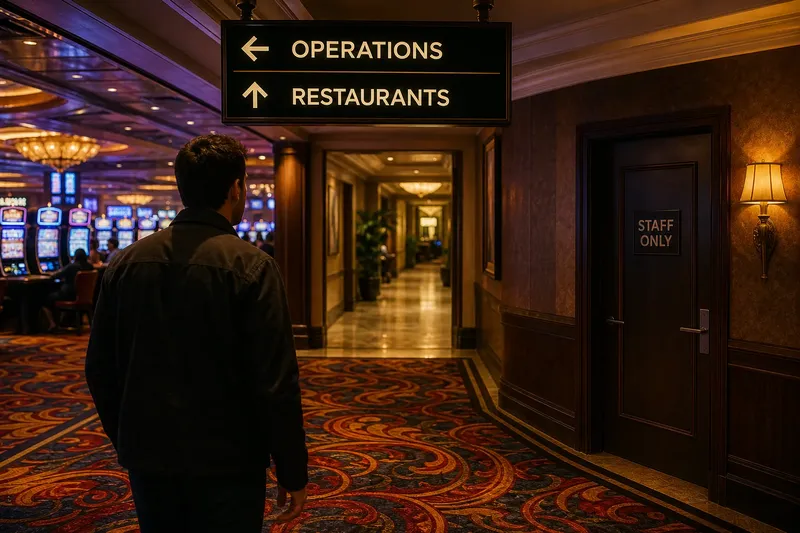
A guest leaves a casino gaming floor to find the hotel reception, but the nearest sign points towards “Operations”. Casino wayfinding signs should translate the venue’s internal layout into clear guest-facing choices, without sending people towards staff spaces or relying on labels they do not recognise.
Write signs for the guest’s next decision
At each junction, make the sign answer a practical question: which way leads to the destination the guest wants? Put the destination first, then give a direction that matches the route on the floor. Avoid internal labels such as “Operations” unless they are also a destination guests are meant to visit.
Use the same public-facing name on direction signs, directories and maps. “Hotel reception” should not become “Guest services” at one junction and “Lobby desk” on the map unless those names clearly identify separate places.
Make staff boundaries legible without exposing staff routes
Guests may encounter a staff door beside a public corridor, especially near a gaming floor, restaurant or service point. Mark the boundary with direct wording such as “Staff only” where it prevents confusion; do not use a staff doorway as a directional landmark for a guest destination.
Think of each sign as a label on a drawer: the label should help you choose the right one, not reveal every item kept elsewhere in the cabinet. Keep internal department names and back-of-house route details off guest-facing directions unless they serve a clear visitor need.
Make temporary changes visible at the point of choice
A closed corridor can make an otherwise familiar route misleading. Put the closure message before the guest reaches the blocked passage, and point to the usable alternative where one is available. Remove, cover or amend the old direction so it does not compete with the temporary instruction.
For a recurring closure, coordinate the wording across the gaming floor, nearby junctions and venue map. A notice at the blocked door alone may come too late to help someone choose another way.
Use a guest-facing sign review to resolve each ambiguity
- Destination wording: If a sign uses an internal term such as “Operations”, replace it with the recognisable guest destination; otherwise, compare it with the map and retain the shared public name.
- Direction at a junction: If the arrow points towards a staff door or a route guests cannot use, redirect it to the public approach; otherwise, keep the arrow and check the next decision point.
- Staff boundary: If a guest could mistake a staff entrance for a public passage, add clear “Staff only” wording; otherwise, avoid adding unnecessary internal detail.
- Temporary closure: If a barrier blocks the signed route, place a closure message before the junction and name the available alternative; otherwise, leave the direction in place and check whether the route remains open to guests.
- Multiple destinations: If “Hotel reception” and “Hotel exit” could be confused, give each a distinct destination label; otherwise, retain the wording and check that the map uses it too.
- Map agreement: If the map and signs call the same place by different names, choose one guest-facing term and update both; otherwise, keep the shared wording and check any nearby directory.
- Help required: If a guest must ask staff to reach a destination, say where to seek assistance; otherwise, do not imply that help is needed.
Which casino sign details should guests be able to resolve?
Should signs name staff-only areas?
Usually, a direct boundary notice is more useful than a list of staff departments. Name a restricted area only when guests need to distinguish its entrance from a public route.
How should a casino distinguish its exits?
Use names tied to places guests recognise, such as “Hotel exit” or “Car park exit”. Repeat those labels on signs and maps so a guest can match the direction to the intended destination.
What should a sign say during a closure?
State that the route is closed and give the available alternative if one is confirmed. Place the notice before the decision point, then remove or cover directions that still point towards the closure.
When should a sign direct guests to staff for help?
Use an assistance instruction when a guest cannot identify or reach the intended destination without help. Name a clear place to ask, such as the information desk, if that service point is available.
How can a casino sign review follow the guest’s actual choices?
Say a hypothetical casino has a gaming-floor sign reading “Operations”, a restricted door beyond the arrow, a map showing “Hotel reception”, and a public corridor that reaches reception by another route. The starting inputs are those four items; the review’s decision is whether the sign names a usable guest route to the same destination as the map.
- Compare “Operations” on the sign with “Hotel reception” on the map. The labels do not match, so choose “Hotel reception” as the guest-facing destination.
- Check the door identified by the arrow. It is staff-only, so remove the arrow pointing towards it and do not describe that passage as a guest route.
- Follow the public corridor shown on the map to reception. If it reaches the named destination without crossing the restricted door, use that corridor as the sign’s route; if it does not, ask venue staff to confirm an accessible guest route before posting a direction.
- Update the gaming-floor sign to name “Hotel reception” and direct guests towards the confirmed public corridor. Update the map as well if its route or destination label differs.
- Read the revised sign at the junction and compare it with the map. Keep the wording only if both point to the same public destination and the arrow no longer leads towards the staff door; otherwise, correct the conflicting instruction.
The expected observable result in this hypothetical situation is a guest-facing sign that names reception and points towards the public corridor, while the staff door remains clearly outside the route. A focused review of casino wayfinding signs should follow the guest’s decision from the gaming floor to the next public destination, not reproduce the venue’s internal route map.